Screwless Dental Implant Turkey
Are you afraid of surgery, or worried about the recovery process? Screwless dental implants eliminate the biggest drawbacks of other implant methods: no incisions, no stitches, and no lengthy recovery period. With this minimally invasive technique performed at our Alanya clinic, you’ll have your temporary tooth on the same day and can return to your normal life the very next day.
Every year, thousands of patients choose Antalya for screwless implant treatment in Turkey. The reason is simple: world-class treatment at prices well below European levels — and right on the Mediterranean coast.
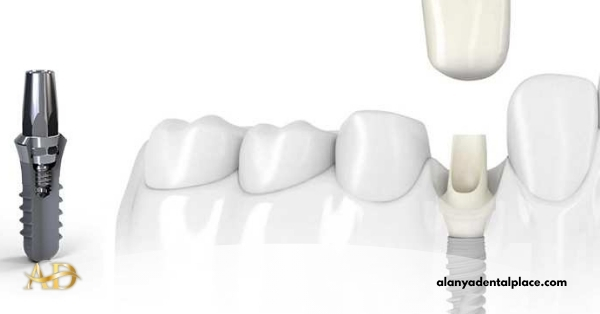
What is a screwless dental implant in Turkey? How does it differ from other methods?
The name might be a bit misleading — let us explain.
A conventional implant system consists of two main parts: a titanium body, which is screwed into the jawbone, and the superstructure (crown or bridge) attached to this body. In the method known as a ‘screwless implant’, the superstructure (crown) is fixed to the underlying implant body using a special adhesive cement rather than a screw. For this reason, it is also referred to in the technical literature as a ‘cement-retained implant superstructure’ or a ‘cemented implant’.
However, in practice, patients use this term in a broader sense: incision-free, flapless implant surgery. In this method, no large incision is made in the gum, no stitches are required, and the recovery time is significantly reduced.
Our clinic caters to both meanings: we offer both aesthetic mounting options that do not use screws in the superstructure and minimally invasive, flapless surgical techniques.
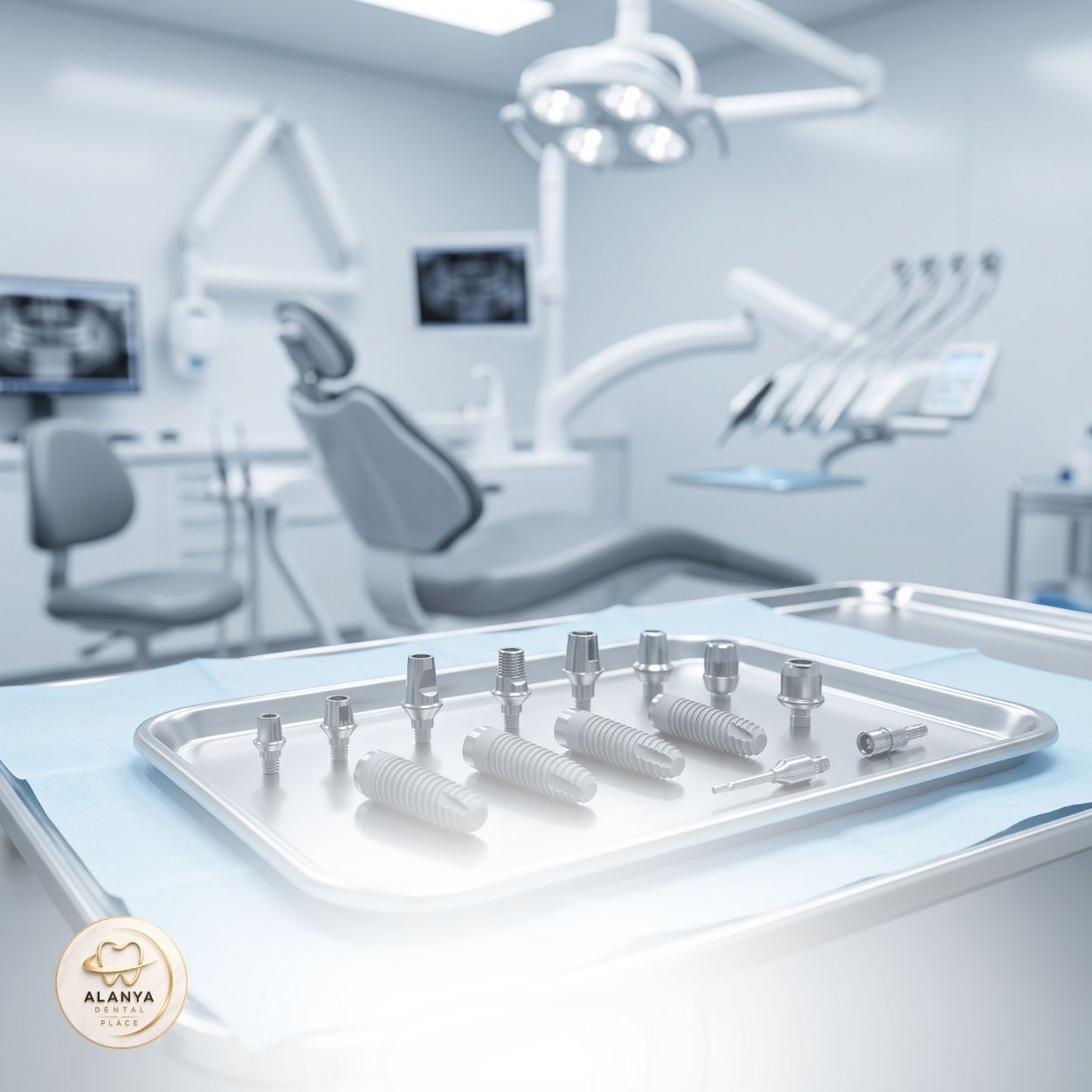
The dental implant brands we work with that are CE-certified






The Advantages of Screwless Implants: Why Are They So Popular?
Who Can Have a Screwless Implant?
The answer to this question depends entirely on individual circumstances. However, the following general criteria remain valid:
Suitable candidates:
- Those with sufficient bone density and volume
- Those in good general health with a systemic condition that is under control
- Those who do not smoke or are ready to give up
- Those with sufficient gum thickness
Situations requiring careful consideration:
- Severe bone loss (grafting may be required)
- Uncontrolled diabetes
- Active cancer treatment or use of bisphosphonate medication
- Severe bruxism (the habit of clenching one’s teeth at night)
Önemli not: Flepsiz tekniğin uygulanabilmesi için yeterli kemik hacmi şarttır. Bu nedenle 3D BT görüntülemesi (CBCT) ilk muayenede mutlaka yapılır. Kemik yeterliyse flepsiz uygundur; değilse geleneksel cerrahi veya önce kemik grefti planlanır — her durumda en doğru çözümü birlikte değerlendiririz.
Contents
Treatment Process: How Are Screwless Implants Fitted in Alanya?
Stage 1 — 3D CT Analysis and Digital Planning
A three-dimensional map of your jawbone is created using panoramic X-rays and CBCT (cone-beam computed tomography). The exact angle, depth and diameter of the implant are planned digitally using these images. There are no surprises — we know exactly where the implant will be placed before it is inserted into the bone. At this stage, our clinic can also perform digital smile design (DSD) if required. This option is particularly valuable for patients who wish to see the treatment outcome on screen beforehand.
Stage 2 — Production of the Surgical Guide
Using the planning data, a 3D-printed template is produced to determine the exact position of the implant. When this template is placed in the mouth, the surgical procedure proceeds with computer-controlled precision. The margin of error attributable to human factors is reduced to a minimum.
Stage 3 — Minimally Invasive Surgery
Local anaesthetic is administered. Guided by a surgical template, a small puncture is made in the gum, or no incision is made at all. The implant is placed into the bone as a titanium screw — this step is the same as with a traditional implant. The difference lies in the approach to the gum: there is no large incision or stitches. The procedure usually takes between 20 and 40 minutes for a single tooth.
Stage 4 — Temporary or Permanent Crown
If bone quality and primary stability are adequate, a temporary crown is fitted on the same day. Once osseointegration (the fusion of the implant with the bone) is complete — usually after 3–4 months — the permanent zirconia crown is fitted. Aesthetically superior results are achieved when a special cement is used instead of a screw to secure the permanent crown.
Full Process Summary (For Medical Tourism Patients)
| Visit | Transaction | Duration |
|---|---|---|
| Day 1 | 3D CT scan + consultation + planning | 1–2 hours |
| Day 2 | Surgical + temporary crown | 1–2 hours |
| Days 3–5 | Control | 30 minutes |
| Months 3–4 (remote) | Monitoring of osseointegration | Digital |
| Next visit | Permanent crown fitting | 1 hour |
A second short visit is all that’s needed for a permanent crown — which for most of our patients means another holiday in Alanya.

Prices for Screwless Implants in Antalya: How Much Should You Set Aside in Your Budget?
Implant prices in Turkey are 60–70% lower than in countries such as Germany or Sweden. This difference is not due to quality; it stems from labour costs, the structure of clinical expenses and exchange rate advantages.
| Application | Estimated Price Range |
|---|---|
| Single-tooth screwless implant (including crown) | 600 – 1.000 € |
| Digital planning + surgical guide | 150 – 250 € (ek) |
| Temporary crown (same-day fitting) | 100 – 200 € (ek) |
| If a bone graft is required (small) | 300 – 600 € (ek) |
| All-on-4 / All-on-6 full arch | 4.500 – 8.000 € |
Our commitment to transparency: In the written quote provided to you following your consultation at our clinic, all items are listed separately. No treatment will commence without your approval. We have no hidden costs.
Many of our patients who research dental implant prices in Antalya are surprised to find that the total cost of flight, hotel and treatment does not exceed the cost of treatment alone in their own country. This reality explains why medical tourism has grown so significantly.

Screwless Implant or Screw-Retained Implant? Do You Know the Difference?
The choice between these two options depends entirely on clinical considerations and aesthetic priorities.
A clamp-on (screwless) superstructure is particularly suitable in the following situations:
- For applications in the anterior region and aesthetic zone
- In cases where it is not desirable for the implant angle to extend onto the upper surface of the crown
- In patients where the gum line is aesthetically critical
A bolted superstructure is preferred in the following situations:
- If the angle of emergence of the implant is appropriate (if it emerges from the occlusal or lingual surface)
- In large bridge structures where passive compliance is critical
- If it is anticipated that the unit may need to be dismantled and reassembled in the future
Both options are available at our clinic. We will decide together which one is right for you.
Why Screwless Implants in Alanya? Why Our Clinic?
CBCT and Digital Surgical Planning Infrastructure
Performing flapless implant surgery without 3D imaging and computer-assisted surgical planning is risky. At our clinic, this technology is an integral part of our standard protocol — we do not charge any extra fees.
A Smile Is Possible on the Same Day
With the ‘immediate loading’ protocol, which is applied once sufficient primary stability has been achieved, you can have your temporary crown fitted on the same day. You’ll arrive in Alanya and leave with a smile on your face.
Experienced Implantology Specialists
The flapless technique requires greater experience and more advanced equipment than standard implant surgery. Our dentists’ international training in implantology and their portfolio of hundreds of cases are concrete proof of this assurance.
Medical Tourism Coordination
Airport transfers, hotel recommendations, treatment schedule planning — our coordinators take care of it all. All you need to do is book your flight.
Location: Alanya, Antalya
One of the most beautiful coastlines in the Mediterranean. A historic castle, natural beaches, and a vibrant town centre. Ideal for those who wish to make the most of their osseointegration period—3–4 months—with a short break.
Just how high is the success rate?
Dental implants are one of the most successful long-term treatments in the history of medicine. The scientific literature reports a success rate of over 95% in 10-year follow-ups. Success rates for the flapless technique have been found to be statistically similar to those of traditional surgery — provided the right patients are selected.
The main factors influencing success are: implant quality, precision of surgical planning, the patient’s general health, and adherence to oral hygiene. Our clinic implements a comprehensive protocol to ensure all these factors are carefully managed.
5 Common Misconceptions About Screwless Implants
70% cheaper than prices in your country!
At our Alanya dental clinic, a free initial assessment and a personalised treatment plan for your screwless implant treatment are just a message away.
The place to go for screwless implants in Turkey: Alanya, Antalya.
Over 200 new patients every month





FAQ — Frequently Asked Questions
Questions About Treatment
A screwless implant is a term referring to a prosthetic system in which the crown is cemented in place rather than secured with screws, using a flapless surgical technique that does not require an incision in the gum or sutures. Compared to the traditional method, it is less invasive, has a shorter recovery time and offers superior aesthetics. However, it cannot be used for every patient; an assessment of bone density is essential.
No. The entire procedure is carried out under local anaesthetic. As there are no incisions or stitches, post-procedure pain and swelling are significantly less than with traditional surgery. Most of our patients are able to eat comfortably on the evening of the procedure.
In Alanya, screwless implant treatment for a single tooth, including the crown, is priced at approximately €600–€1,000. This is 60–70 per cent lower than prices in Germany or the UK. The exact price is determined following a 3D CT scan.
Provided the right patients are selected and a 3D planning infrastructure is in place, the procedure is extremely safe. The use of surgical guides reduces the margin of error to a minimum. Data published by international implantology associations show that success rates are comparable to those achieved with traditional techniques.
Yes, in suitable cases. In this protocol, known as ‘immediate loading’, a temporary crown is placed on the same day provided there is sufficient bone quality and primary stability. The permanent crown is fitted following osseointegration (3–4 months).
The surgical stage for a single tooth usually takes 20–40 minutes. 3D analysis and planning require additional time. For medical tourism patients, the total treatment time is usually completed within 2–3 days.
The implant body is designed to last a lifetime; scientific studies document success rates of over 20 years. Cement-retained restorations (crowns), however, can last for 10–15 years or longer, depending on the quality of the materials and oral hygiene.
The flapless technique cannot be performed. In this case, a bone graft is planned first, and once sufficient bone has formed (usually 4–6 months), the implant surgery is carried out. Alternatively, methods such as angled implants or All-on-4 may be considered.
Smoking has a negative impact on the osseointegration process and increases the risk of implant failure. It is not an absolute contraindication; however, it is strongly recommended that you stop smoking at least two weeks before and two months after the procedure. It is important that you discuss your current situation with our doctor.
A minimum of 3–5 days is sufficient for the initial dental appointment. A brief follow-up appointment is required approximately 3–4 months later for the permanent crown. Many of our patients turn this second appointment into a holiday opportunity.
- World Health Organization (WHO) — Oral Health Global Status Report
https://www.who.int/publications/i/item/9789240061484 - FDI World Dental Federation — Implantology Standards and Guidelines
https://www.fdiworlddental.org/ - International Journal of Oral & Maxillofacial Implants — Flapless implant surgery outcomes: a systematic review
https://quintpub.com/journals/omi/ - Clinical Oral Implants Research — Cement-retained vs. screw-retained implant restorations: a systematic review (Wiley)
https://onlinelibrary.wiley.com/journal/16000501 - Journal of Clinical Periodontology — Peri-implant health, peri-implant mucositis and peri-implantitis: Case definitions
https://onlinelibrary.wiley.com/journal/1600051x - Cochrane Oral Health — "Interventions for replacing missing teeth: implants for single teeth"
https://www.cochranelibrary.com/ - European Association for Osseointegration (EAO) — Consensus Report on Immediately Loaded Implants
https://www.eao.org/ - International Team for Implantology (ITI) — Consensus Statements on Flapless Implant Surgery
https://www.iti.org/ - Journal of Prosthetic Dentistry — Digital workflow in implant prosthodontics
https://www.thejpd.org/ - Türk Oral ve Maksillofasiyal Cerrahi Derneği (TOMS) — Klinik uygulama standartları
https://www.toms.org.tr/
Do you have any other questions?