Orthodontics — Alanya & Antalya
Do you have crooked teeth, a misaligned bite, or a smile you’ve been putting off for a long time? At our clinics in Alanya and Antalya, orthodontic treatment has been redesigned to deliver both aesthetic and healthy results. With modern methods such as clear aligners, metal braces, ceramic braces and lingual orthodontics, a world-class treatment experience awaits you on Turkey’s sunny coast.
📅 FREE INITIAL CONSULTATION — Book an Appointment Now | WhatsApp · Phone · Online Form
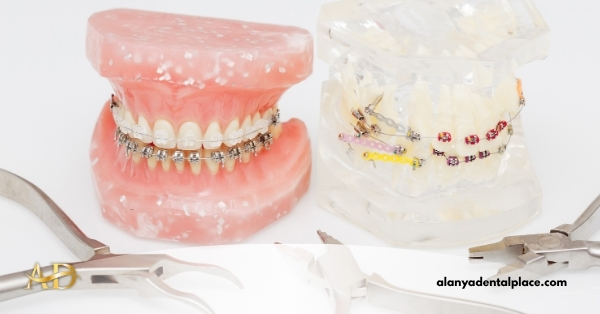
Clear Aligners · Metal Braces · Lingual Orthodontics · Digital Treatment Planning
What is Orthodontics? Why is it so popular in Alanya?
Orthodontics is a branch of dentistry that examines the alignment of the teeth, jaw and facial skeleton, and diagnoses and treats malocclusions. It is not merely a matter of aesthetics: crooked or crowded teeth create areas where plaque is difficult to remove, can lead to temporomandibular joint (TMJ) problems and may cause speech disorders. There is a common saying within the dental profession:
Alanya is a vibrant city all year round, welcoming visitors from both within Turkey and abroad. This dynamic atmosphere means that demand for orthodontic treatment in Alanya far exceeds the national average. Foreign patients who begin treatment during their holiday discover that, thanks to the flexibility of clear aligner treatment, it is possible to receive orthodontic treatment in Turkey at a far more favourable price-quality ratio compared to clinics in Germany, Russia or the UK. Located close to Antalya’s international airport, our clinic supports the coordination of these patients through private transfers and digital monitoring protocols.
Orthodontic Treatment Options in Alanya: Which One Is Right for You?
There is no one-size-fits-all treatment. The most suitable method is selected by taking into account your age, the condition of your teeth, your budget and your aesthetic expectations. Below, you will find a full and transparent overview of the main methods used at our clinic.
The most proven method. A robust and cost-effective solution for moderate to severe cases.
Porcelain braces that match the colour of your teeth. For adults who place a high value on aesthetics.
Removable, virtually invisible. Invisalign and similar systems.
The brackets are bonded to the inner surface of the tooth; they are completely invisible from the outside.
Precise impressions using a 3D intraoral scanner; virtual treatment simulation.
Early intervention appliances, splints and functional orthopaedic devices.
Metal Braces Treatment in Alanya
Metal braces remain the most popular orthodontic treatment in Alanya. No other option strikes such a good balance between high force transmission, durable materials and affordability. Self-ligating brace systems reduce the time between appointments, shortening treatment by an average of 25%. The option of coloured ligatures improves compliance with treatment among children and young patients.
Ceramic (Porcelain) Braces Treatment in Alanya
Thanks to their tooth-coloured shades, ceramic braces are virtually invisible from a distance of 1–2 metres. Adult patients in Alanya who opt for ceramic braces generally choose this option due to concerns about their appearance in the workplace. Modern ceramic braces, which have a low coefficient of friction, offer a force transfer comparable to that of metal braces.
Clear Aligner Treatment — Invisible Orthodontics in Turkey
At our clinic, clear aligner treatment is offered using both world-renowned brands (including Invisalign) and high-quality, locally manufactured aligner systems produced in Turkey. The treatment simulation, created following a digital 3D scan, allows patients to visualise the treatment outcome before it begins. During this process, which typically takes between 6 and 18 months, patients can remove the aligners themselves, eat normally and maintain good oral hygiene with ease. The cost of clear aligner treatment in Turkey is 35–55% more affordable than in European clinics; this presents an excellent opportunity for those wishing to start their treatment whilst enjoying a holiday in Alanya.
Lingual Orthodontics
In this system, where the brackets are placed on the back of the teeth—that is, the surface facing the tongue—nothing is visible from the outside. It is ideal for presenters, stage performers and brides-to-be. The adaptation period is longer than with metal braces; however, for patients with cases involving the front teeth and where aesthetics are a high priority, it is undoubtedly the most comfortable invisible alternative. At our clinic, Alanya lingual orthodontic treatment is carried out by our experienced team of specialists.
Contents
Who is eligible for orthodontic treatment? Is there an age limit?
The American Association of Orthodontists and the Turkish Orthodontic Society recommend that the first orthodontic assessment be carried out at the age of 7. This period, known as the mixed dentition stage when both milk teeth and permanent teeth are present, is the most suitable time for orthopaedic appliances that guide jaw development. Early intervention significantly reduces the need for future extractions and shortens the duration of treatment. Families with children of all ages visit our clinic in Alanya for paediatric orthodontics.
This period, when bone growth is nearing completion, is the golden age of traditional fixed orthodontic treatment. Braces offer the greatest potential for rapid tooth movement at this age. Given the demands of school and social life, ceramic braces or aligners are often the preferred choice.
Orthodontic treatment is not impossible once bone development is complete; it simply takes a little longer. For adult orthodontics, clear aligners or lingual systems are the preferred options in terms of aesthetic appeal. Planning treatment that is compatible with existing fillings, crowns or implants is an area in which our clinic excels. A significant proportion of the demand for adult orthodontics in Alanya comes from international patients visiting from Europe during the holiday season.
How Does Orthodontic Treatment Work in Alanya? A Step-by-Step Guide
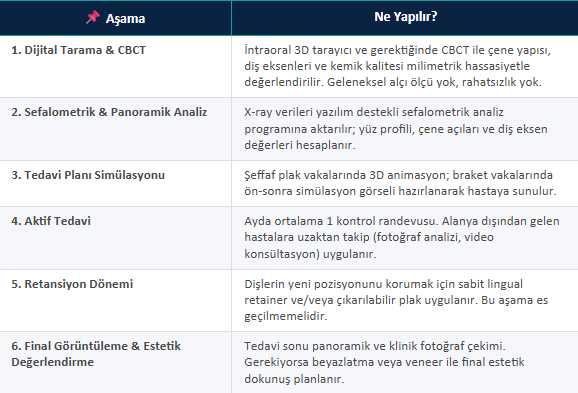
Turkey is carving out an increasingly significant place on the dental tourism map year on year, thanks to treatment costs that are 40–60% of those in European Union countries, clinics accredited by JCI or ISO, and a highly trained team of specialists. Antalya and Alanya are among the leading destinations in this sector, thanks to their influx of international tourists and well-established infrastructure.
For international patients opting for clear aligner treatment in particular, the process works as follows: During your first visit, all scans and the treatment plan are completed, and your aligners are ordered. Once you return to your home country, progress is monitored via remote photo tracking. When you return to collect your next set of aligners, you can have a check-up and enjoy the unique beauty of Alanya once again.
An accurate diagnosis starts with the right tools. The technological infrastructure available at our clinic:
- ✓ 3D Intraoral Scanner — A digital alternative to traditional plaster impressions; accuracy of less than 20 microns.
- ✓ CBCT (Cone Beam Computed Tomography) — 3D cross-sectional imaging for assessment of the jawbone, root positions and airway.
- ✓ Digital Cephalometric Analysis Software — Precise calculation of facial skeletal relationships; treatment plan simulation.
- ✓ Self-Ligating Bracket Systems — Low friction, fewer appointments, shorter treatment duration.
- ✓ Aligner Thermoforming Unit — Digital workflow for rapid prototyping and aligner production.
- ✓ Laser-Assisted Soft Tissue Intervention — Minimally invasive for gingival corrections prior to bracket placement.
- ✓ Remote Monitoring Protocol — A photo-based digital monitoring system for international patients.
- Specialist Team: Specialists holding master’s and doctoral degrees in orthodontics; members of the Turkish Orthodontic Society.
- Single-Session Digital Plan: The scan, simulation and treatment plan are completed during your first appointment; you can make your decision before your second visit.
- International Patient Coordination: Remote monitoring, online consultations and multilingual communication (TR/EN/RU).
- Alanya’s Location: Close to both Antalya Airport and the region’s most beautiful beaches; your treatment won’t get in the way of your holiday.
- Transparent Pricing: Each item is listed separately in the written treatment plan prepared following the consultation.
- Pathology Protocol: All clinical data is digitally archived; you can access your file from anywhere in the world in the years to come.
- Aesthetic Integration: Post-orthodontic teeth whitening, veneers or smile design, all under one roof, where required.
- Warranty: Any faults with materials covered by the warranty will be repaired free of charge throughout the treatment.
At what age should orthodontic treatment begin?
The first orthodontic assessment should take place at the age of 7. At this age, bone development can be guided, and early intervention often results in a shorter and simpler treatment compared to later stages. In adults, there is no upper age limit for starting treatment; even patients who begin treatment in their 50s achieve excellent results.
Are clear aligners or metal braces better?
There is no one-size-fits-all answer to this question. Clear aligners are ideal for patients who prioritise aesthetics, are disciplined (requiring 20–22 hours of wear per day), and have mild to moderate cases. Metal braces, however, remain the gold standard for severe crowding, rotation and vertical issues. At our clinic, both options are presented for comparison following a digital simulation; the decision is yours.
I live abroad; can I start orthodontic treatment in Alanya?
Yes, this is a very familiar scenario for us. During the first visit, we carry out a screening, diagnosis and treatment plan, plus fit the initial aligner. Progress is then monitored via monthly remote follow-ups using photographs. With the clear aligner option, all your aligners are ordered in advance; you simply need to visit our clinic at regular intervals to collect them.
Is orthodontic treatment painful?
You may experience a slight sensation of pressure for 2–4 days at the start of treatment and after each new aligner is fitted. This is not pain, but a sign that your teeth are moving. It can be easily managed with over-the-counter painkillers such as paracetamol. The vast majority of our patients report feeling almost no pain at all, particularly with clear aligner treatment.
How long does orthodontic treatment take?
Mild cases are completed in 6–12 months, moderate cases in 12–18 months, and severe cases in 18–30 months. Self-ligating bracket systems can reduce treatment time by 20–25% compared to conventional brackets. The exact duration is determined at the initial assessment.
What can I eat during orthodontic treatment?
Those wearing braces should avoid hard, sticky and fibrous foods: apples, hard bread crusts, chewing gum and nuts. Those wearing clear aligners, on the other hand, can remove their aligners and eat whatever they like — this is the biggest practical advantage of aligners.
Is a retainer compulsory after orthodontic treatment?
Absolutely. The retainer is the most critical stage in consolidating the teeth’s new position and preventing relapse. It is fitted as a fixed lingual retainer (a thin wire bonded to the back of the tongue) and/or a removable clear aligner. If this stage is skipped, the teeth tend to revert to their original positions.
Why are orthodontic treatment costs more affordable in Turkey?
Labour and overhead costs in Turkey are structurally lower than in Western Europe. This stems not from the clinic’s profits, but from the general structure of the economy. The brands of materials used (such as 3M, Ormco and Dentsply Sirona) may be exactly the same; it is simply the clinic’s operational costs that differ.
Can I have dental implants or veneers fitted at the same time as orthodontic treatment?
General rule: orthodontics first, then aesthetic restoration. Once the teeth are in the correct position, the implant site, veneer proportions and smile design can be planned in the most optimal way. However, in some cases, orthodontics and implant treatment are carried out simultaneously; this decision is made following an interdisciplinary assessment at our clinic.
How can I get to your orthodontic clinic in Alanya?
The distance by road from Antalya Airport to Alanya is approximately 2 hours (130 km). Airport transfers can be arranged by our clinic. It is possible to reach Alanya much more quickly from Gazipaşa-Alanya Airport.
Can patients use SGK or private health insurance at your clinic?
If your private insurance policy includes “Orthodontic Cover”, we can process your claim. The Social Security Institution (SGK) provides very limited cover for orthodontics; we recommend that you call our clinic for further information. Payment plans are available.
Sources & References
This content has been prepared based on the following academic, clinical and institutional sources:
- Proffit WR, Fields HW, Larson B, Sarver DM. Contemporary Orthodontics. 6th ed. Elsevier; 2018.
- Türk Ortodonti Derneği (TOD) — Klinik Uygulama Rehberi, 2023. www.ortodonti.org.tr
- American Association of Orthodontists (AAO) — Clinical Practice Guidelines 2022. www.aaoinfo.org
- Invisalign Clinical Research — Treatment Outcomes in Adult Patients. Align Technology White Paper; 2021.
- Fleming PS. Orthodontic bonding with self-ligating brackets. Seminars in Orthodontics. 2017;23(2):163–171.
- Türkiye Cumhuriyeti Sağlık Bakanlığı — Diş Hekimliği Uygulama Standartları, 2023.
- Buschang PH, et al. Predicted and actual end-of-treatment occlusion produced with clear aligners. Angle Orthodontist. 2015;85(5):723–727.
- World Health Organization (WHO) — Oral Health: Key Facts. www.who.int/news-room/fact-sheets/detail/oral-health
- Kuncio D, Maganzini A, Shelton C, Freeman K. Invisalign and traditional orthodontic treatment postretention outcomes compared. Angle Orthodontist. 2007;77(5):864–869.
- Nanda R. Biomechanics and Esthetic Strategies in Clinical Orthodontics. Elsevier; 2005
Do you have any other questions?