Treatment of Dental Cysts and Cyst Removal in Turkey
A swelling you feel in your mouth, tenderness in the jaw, or a shadow picked up incidentally on an X-ray—all of these could be signs of a dental cyst. At our clinic serving Alanya and Antalya, we offer same-day appointments, minimally invasive procedures and lasting results using modern techniques such as dental cyst surgery, cyst enucleation and apical surgery. World-class dental surgery is now much closer at hand in Turkey’s most beautiful coastal cities.

What is a dental cyst? Why should it be taken seriously?
A dental cyst is a sac-like formation that develops within the jawbone or gum tissue and contains fluid or semi-solid material. Known in medical literature as odontogenic cysts, these structures start out small and grow over months, sometimes years, without causing any symptoms. This is where the real danger lies: by the time they are detected, they may have caused serious damage to surrounding teeth, bone tissue, or even nerve canals.
A significant proportion of patients visiting our clinics in Antalya and Alanya are diagnosed with gingival cysts, root-end cysts (radicular cysts), dentigerous cysts and keratocysts. Thousands of people in Turkey are diagnosed with these conditions every year; if treatment is delayed, it can lead to the need for jawbone resection. Early diagnosis and timely dental cyst surgery both shorten the treatment process and significantly reduce costs.
The Most Common Types of Dental Cysts
The dental implant brands we work with that are CE-certified






Symptoms of a Dental Cyst: How Can You Check for Them?
The insidious nature of dental cysts is that they can remain asymptomatic for a long time. However, at a certain point, the signals the body sends us begin to become clearer. If you are experiencing any of the following symptoms, we strongly recommend that you book an urgent assessment appointment at our clinic in Alanya or Antalya.
- Unexplained swelling or asymmetry in the jaw or face
- Spontaneous movement or loosening of the teeth
- Pain and pressure felt when biting or chewing
- Numbness — particularly in the lower jaw, lip or chin (indicating nerve compression)
- Recurrent, antibiotic-resistant abscesses and infections
- A sensation of pressure in the sinuses or nose (in the case of maxillary cysts)
- A radiolucent area incidentally detected on panoramic or CBCT imaging
Even if there are no symptoms, having a panoramic X-ray taken once a year is the most reliable way to detect these risks at an early stage. At our clinics in Antalya and Alanya, we carry out assessments with millimetre-level precision using digital panoramic X-rays and cone-beam computed tomography (CBCT).
Dental Cyst Surgery in Alanya & Antalya: Which Method Is Right for You?
Treatment for dental cysts in Turkey is not limited to a single method. The most appropriate treatment plan is determined based on the size, location and type of the cyst, as well as the patient’s general state of health. At our clinic, all these procedures are carried out by specialist oral and maxillofacial surgeons.
1. Cyst enucleation (complete cyst removal) is being performed.
This is the most commonly used method for dental cyst surgery. The cyst capsule is separated from the healthy jawbone or gum tissue and removed in its entirety; this procedure is known as enucleation. This minimally invasive procedure, which is performed without damaging the surrounding teeth or bone tissue, is carried out under local anaesthesia for the vast majority of patients in Antalya and Alanya.
2. Marsupialisation (Partial Evacuation)
This approach is preferred in cases of large cysts or where there is insufficient space between the cyst and critical anatomical structures (such as the neural canal or the base of the sinus). The cyst sac is opened, its contents drained, and the cyst is allowed to shrink gradually. In the second stage, the remaining tissue is removed. This two-stage approach is a safe alternative, particularly for paediatric and young adult patients in Turkey.
3. Apical Resection (Root-Tip Surgery)
In cases of radicular cysts—that is, cysts at the root tip—apical resection is performed whenever it is possible to save the tooth. The infected root tip and the surrounding cyst tissue are removed together; the resulting cavity is supported with a bone graft. When this procedure is combined with root canal treatment, the success rate is very high. At our clinic in Alanya, both root canal treatment and apical surgery can be completed in a single session.
4. Laser-Assisted Cyst Surgery
High-energy dental lasers create a sterile surgical field in soft-tissue cysts (such as gingival cysts), improve haemostasis and accelerate the healing process. Dental cyst surgery using lasers offers the advantages of minimal suturing and rapid healing, particularly in cysts originating from the gums. Diode laser technology is actively used at our centres in Antalya and Alanya.
5. Piezoelectric Surgery (Ultrasonic Bone Cutting)
In cases requiring delicate bone surgery, the piezo device, which operates using ultrasonic vibrations, cuts only hard tissue (bone); it does not damage soft tissue, blood vessels or nerves. This technology is used at our Alanya clinic specifically to create a bone window around large cysts; post-operative swelling and pain are significantly reduced.
Contents
How Is a Dental Cyst Operation Performed? A Step-by-Step Guide
No patient who takes their first step into our clinic undergoes a procedure without knowing exactly what to expect. In line with our principle of transparency, we clearly explain every stage of the process.
The size, boundaries, relationship with neighbouring structures and any potential pathological features of the cyst are determined by taking a panoramic X-ray or, where necessary, a CBCT scan. Unlike many clinics in Turkey, we never proceed with treatment planning without a CBCT scan if a 2D image is insufficient.
Our specialist surgeon will explain the most suitable procedure for you, along with the reasons behind it. For tourists visiting from Antalya or Alanya, same-day surgery can be arranged for cases that do not require intensive care.
The vast majority of cases can be comfortably managed under local anaesthesia. For patients with high levels of anxiety, conscious sedation (laughing gas or intravenous sedation) is administered; this ensures that the patient remains calm and pain-free throughout the procedure.
The area around the cyst is opened, the capsule is carefully separated and removed in its entirety. Where necessary, the cavity is supported with an autogenous bone graft or biomaterials to promote bone regeneration.
All excised cyst tissue is sent to the pathology laboratory. This step cannot be omitted, as some cystic lesions may be confused with more aggressive conditions such as ameloblastoma or may show signs of malignant transformation.
Clinical examinations and radiological assessments are carried out at the 1-week, 1-month and 6-month check-ups. Please do not miss these follow-up appointments, as they are essential for the early detection of any risk of recurrence.
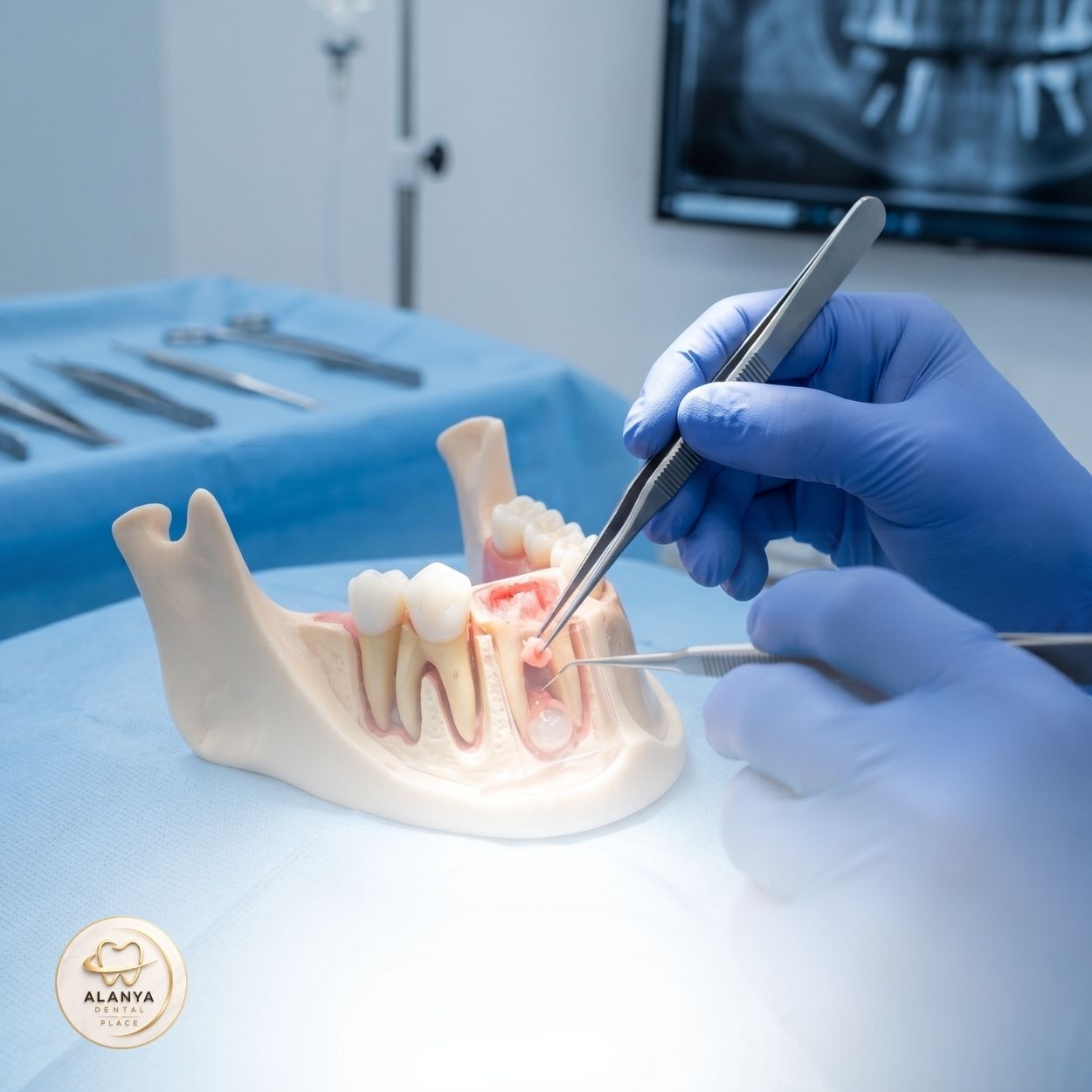


What complications can an untreated dental cyst lead to?
‘I’m not in any pain, so why should I have surgery?’ is a perfectly natural question; however, although dental cysts can develop without causing pain, they can cause irreversible damage to the surrounding tissues. Here are some real clinical complications that illustrate the cost of delaying treatment:
- Risk of bone resorption and pathological fracture — as the cyst grows, it erodes the bone from within.
- The roots of adjacent healthy teeth may dissolve (resorption), and those teeth may also be lost.
- If the inferior alveolar nerve is compressed, permanent numbness or loss of sensation may develop.
- A large cyst may open into the maxillary sinus; this can lead to chronic sinusitis and nasal congestion.
- The source of infection spreads via the bloodstream, potentially leading to life-threatening conditions such as abscesses and cellulitis.
- Keratocysts and certain types of cysts can develop into malignant tumours (ameloblastoma, squamous cell carcinoma).
Unfortunately, some of the patients who come to our clinics in Antalya and Alanya present with late-stage complications. The story is the same for every one of them: ‘I knew I should have done something, but I put it off.’ Given the quality and accessibility of healthcare services in Turkey, there is no longer any valid excuse for delaying early intervention.
Recovery Process and Aftercare Following Dental Cyst Surgery
One of the most pressing questions patients ask is, ‘How long will it take for me to recover?’ The honest answer is that, whilst it depends on the size of the cyst, the procedure performed and the patient’s general health, most patients feel well enough to leave the clinic on the day of the operation.
The First 48 Hours
- Cold therapy (ice packs) reduces swelling when applied for 20 minutes followed by a 20-minute break.
- Analgesics should be taken at regular intervals; pain is likely to be less than expected. • Eat soft foods (yoghurt, purées, soup); avoid chewing in the area of the operation.
- Smoking and alcohol are strictly prohibited — they increase the risk of blood clots and dry socket.
Week 1
- Bruising and slight swelling in the area where the stitches were placed are normal and will gradually subside.
- Continue taking the antibiotics and using the mouthwash as instructed by your doctor.
- Avoid scrubbing the surgical area with a stiff brush; clean it using gentle, soft movements.
Weeks 2–4
Most patients can resume their daily routine and normal diet during this period. A CBCT scan is scheduled during this visit if necessary. If a bone graft has been used, full recovery takes 3–6 months; this process does not impose any restrictions.
Dental Cyst Surgery in Turkey: Why Choose Our Clinic in Alanya and Antalya?
Turkey ranks among the top three countries in the world for dental tourism; every year, hundreds of thousands of patients from Europe, the Middle East and Central Asia come to Turkey for dental treatment. There are four key factors driving this demand: competitive pricing, advanced technology, a team of specialists and a high standard of comfort. Alanya and Antalya, meanwhile, combine all these advantages with the warmth of an international tourist destination.
- Experienced Team: Specialists who have completed their specialisation in oral and maxillofacial surgery and received their training at Turkey’s leading universities.
- Advanced Imaging Technology: Accurate diagnosis using digital panoramic imaging, CBCT and intraoral scanners.
- One-off Appointments: Appointment management tailored to patients visiting Antalya or Alanya for a holiday or a short stay.
- Sterile Operating Theatre Standards: Use of materials and equipment compliant with the EN ISO 13485 quality management system.
- Pathology Protocol: All excised tissue must be sent for histopathological examination.
- Services in Turkish, English, Russian and German: patient communication in keeping with Alanya’s multilingual character.
- Easy access: Located close to Antalya Airport; transfer arrangements can be made.

Prices for Dental Cyst Surgery: How Much in Turkey, Antalya and Alanya?
The cost of dental cyst surgery in Turkey reveals a striking difference when compared to European and Gulf countries. For the same quality standards, the cost of dental cyst surgery in Turkey is approximately 40–60% of that in Germany or the UK. The competitive market in Antalya and Alanya makes this difference even more pronounced.
The main factors determining the price are: the size and number of cysts, the method used (enucleation, marsupialisation, apical resection), the need for bone grafting, the type of anaesthesia (local/sedation) and the number of imaging scans required. At our clinic, the price is finalised following the consultation based on an individual treatment plan; there are no hidden additional charges.
Frequently Asked Questions
Questions About Treatment
Is having a dental cyst removed a difficult procedure?
This depends on the size of the cyst, its location and its relationship with the surrounding tissues. Whilst small and easily accessible cysts may be treated more simply, the procedure for larger cysts is carried out in a more planned manner.
Does a dental cyst go away on its own?
Generally, no. Depending on the type and size of the cyst, either monitoring or surgery may be required; cysts that grow can damage surrounding tissues over time.
Are a jaw cyst and a tooth cyst the same thing?
In everyday language, these terms are often used interchangeably; however, from a medical perspective, the location, origin and type of the cyst are important. Lesions that form within the jawbone can be classified into different categories.
Is the tooth extracted when the cyst is removed?
In some cases, yes. In particular, where a tooth is associated with a cyst and cannot be saved, the tooth may be extracted along with the cyst. This decision depends on the type of cyst and the condition of the tooth.
Does a dental cyst go away on its own?
No. Dental cysts do not heal on their own; on the contrary, they continue to grow. A small cyst may go unnoticed for years, but it expands by eroding the surrounding tissues. Once diagnosed, treatment should be planned as soon as possible.
Can an implant be fitted after cyst surgery?
Yes, in many cases, an implant can be planned depending on the healing process and the condition of the bone; however, the cyst must first be safely removed and the area assessed. This decision is made on the basis of a clinical examination and imaging.
Is dental cyst surgery very painful?
No, you will not feel any pain during the operation thanks to the local anaesthetic. You may experience some mild discomfort in the first 24–48 hours after the operation; the prescribed painkillers will easily keep this under control. The vast majority of our patients return to their normal activities the very next day.
How long does the operation take?
Although this varies depending on the size of the cyst and the technique used, a standard enucleation takes between 30 and 60 minutes. Larger cysts or cases requiring marsupialisation plus a second session may take longer.
When can I return to work after dental cyst surgery?
If you have a desk-based or office job, you can usually return to work the following day. For jobs requiring physical exertion, 3–5 days’ rest is recommended. Foreign patients visiting Antalya or Alanya for dental tourism can fly home after resting in the city for 2–3 days following their operation.
Can an implant be fitted in place of a tooth that has had a cyst removed?
Yes, but timing is crucial. A waiting period of 3–6 months is usually required for bone healing following enucleation; the dental implant is then planned. At our clinic, areas supported by bone grafting often shorten this period. We offer a one-stop solution for the combination of dental implants and cyst surgery in Turkey.
Can the cyst recur?
The recurrence rate for radicular cysts is low. In odontogenic keratocysts, however, the risk of recurrence is higher; therefore, in addition to enucleation, further measures such as the application of Carnoy’s solution or bone resection may be taken for this type of cyst. It is crucial that you do not miss your regular follow-up appointments.
What is the process for patients coming from outside Antalya or Alanya?
Patients applying from other cities in Turkey or from abroad can arrange a remote preliminary assessment by sending their existing imaging files (panoramic, CBCT) digitally. On the day of their arrival at our clinic, we can schedule a consultation, imaging and, where appropriate, surgery on the same day. We can assist with accommodation.
Is laser surgery for dental cysts suitable for all types of cysts?
Laser-assisted surgery is particularly ideal for superficial gum cysts and small soft-tissue lesions. For large, intraosseous cysts, laser treatment alone is not sufficient; it must be combined with traditional surgical techniques. Our clinic offers both technologies and selects the most appropriate method on a case-by-case basis.
Will I be awake during the operation?
In standard cases, local anaesthesia is administered; the patient remains conscious but feels nothing in the surgical area. For patients who are anxious or have special needs, conscious sedation (IV sedation or nitrous oxide) may be preferred. General anaesthesia is considered for very large and complex cases.
Is it possible to perform surgery for a dental cyst in children?
Yes. Dentigerous cysts are particularly common in children and adolescents. In paediatric cases, marsupialisation is often the preferred treatment; this supports tooth eruption and minimises bone loss. Our clinic offers a gentle approach to treating paediatric patients and has sedation protocols in place where necessary.
What is the difference between a dental cyst and a tumour?
Dental cysts are generally benign lesions, but some may behave aggressively. As ameloblastomas and odontogenic tumours can present with a cystic appearance, it is essential that all excised tissue is sent to a pathology laboratory. It is extremely important that you receive treatment at centres that adhere strictly to this protocol.
Is dental cyst surgery covered by insurance? Does the Social Security Institution (SGK) cover it?
In Turkey, the Social Security Institution (SGK) may contribute towards the cost of dental cyst surgery under certain conditions; however, it should be noted that coverage is subject to the requirement to use a contracted provider and referral procedures. Private health insurance policies generally cover this procedure under the heading of ‘oral and dental surgery’. At our clinic in Alanya or Antalya, we can guide you through the insurance consultation process.
Sources
- Bu içerik hazırlanırken aşağıdaki akademik ve klinik referanslardan yararlanılmıştır:
- Neville BW, Damm DD, Allen CM, Chi AC. Oral and Maxillofacial Pathology. 4th ed. Elsevier; 2016.
- Shear M, Speight PM. Cysts of the Oral and Maxillofacial Regions. 4th ed. Blackwell Munksgaard; 2007.
- Pogrel MA, Costello BJ. Atlas of Oral and Maxillofacial Surgery. Elsevier; 2014.
- Türk Oral ve Maksillofasiyal Cerrahi Derneği (TOMCD) Klinik Uygulama Kılavuzları, 2022.
- World Health Organization (WHO). Classification of Head and Neck Tumours. IARC Press; 2022.
- Rajendra Santosh AB. Odontogenic Cysts. Dental Clinics of North America. 2020;64(1):105-119. doi:10.1016/j.cden.2019.08.007
- Woo SB. Oral Pathology: A Comprehensive Atlas and Text. 2nd ed. Elsevier; 2017. • Türkiye Cumhuriyeti Sağlık Bakanlığı, Diş Hekimliği Hizmetleri Standartları, 2023.
- Blanas N, Freund B, Schwartz M, Furst IM. Systematic review of the treatment and prognosis of the odontogenic keratocyst. Oral Surg Oral Med Oral Pathol. 2000;90(5):553-558.
- De Oliveira BH, Campos V, Marçal S. Compound odontoma: diagnosis and treatment. J Clin Pediatr Dent. 2001;25(3):185-192.
Do you have any other questions?